1. Introduction

In this article, we’ll discuss in detail a core concept in Java – the lifecycle of a thread.

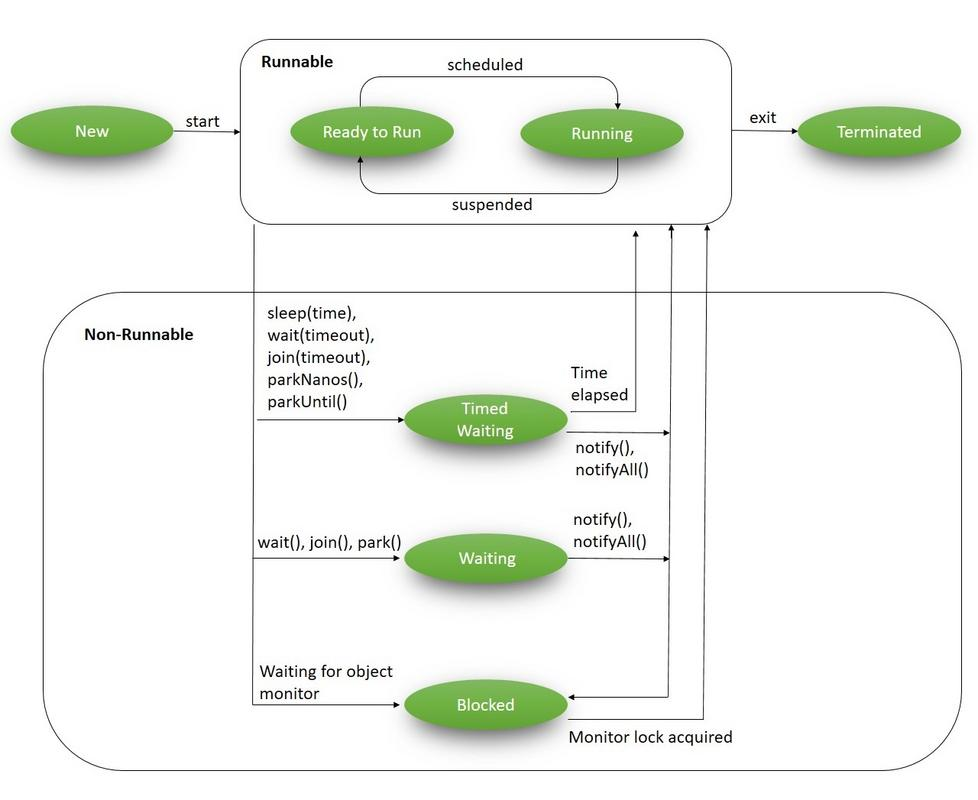
We’ll use a quick illustrated diagram and, of course, practical code snippets to better understand these states during the thread execution.

To get started understanding Threads in Java, this article on creating a thread is a good place to start.

2. Multithreading in Java

In the Java language, multithreading is driven by the core concept of a Thread. During their lifecycle, threads go through various states:

img](https://www.baeldung.com/wp-content/uploads/2018/02/Life_cycle_of_a_Thread_in_Java.jpg)

阅读全文 »

1. Introduction

In this tutorial, we’ll learn about the event support mechanism provided by the Spring framework. We’ll explore the various built-in events provided by the framework and then see how to consume an event.

To learn about creating and publishing custom events, have a look at our previous tutorial here.

Spring has an eventing mechanism which is built around the ApplicationContext. It can be used to exchange information between different beans. We can make use of application events by listening for events and executing custom code.

For example, a scenario here would be to execute custom logic on the complete startup of the ApplicationContext.

阅读全文 »

1. Overview

In this tutorial, we’ll have a look at various ways to override properties in Spring’s tests.

Spring actually provides a number of solutions for this, so we have quite a bit to explore here.

2. Dependencies

Of course, in order to work with Spring tests, we need to add a test dependency:

<dependency>
<groupId>org.springframework.boot</groupId>
<artifactId>spring-boot-starter-test</artifactId>
<version>2.5.1</version>
<scope>test</scope>
</dependency>

This dependency also includes Junit 5 for us.

阅读全文 »

1. Overview

In this tutorial, we’re going to learn different ways to use shutdown callbacks with Spring.

The main advantage of using a shutdown callback is that it gives us control over a graceful application exit.

2. Shutdown Callback Approaches

Spring supports both the component-level and the context-level shutdown callbacks. We can create these callbacks using:

  • @PreDestroy
  • DisposableBean interface
  • Bean-destroy method
  • Global ServletContextListener

Let’s see all of these approaches with examples.

阅读全文 »

1. Introduction

Spring Boot has many useful features including externalized configuration and easy access to properties defined in properties files. An earlier tutorial described various ways in which this could be done.

We are now going to explore the @ConfigurationProperties annotation in greater detail.

Further reading:

A Quick Guide to Spring @Value

Learn to use the Spring @Value annotation to configure fields from property files, system properties, etc.

Properties with Spring and Spring Boot

Tutorial for how to work with properties files and property values in Spring.

阅读全文 »